
Building a functional training space in a domestic setting is often perceived as a significant financial and spatial undertaking. Many individuals delay their health goals, assuming that a professional-grade setup requires an expansive garage or a massive capital investment. However, as urban living spaces consolidate, the trend in wellness has shifted toward “essentialism.” Creating a sustainable, high-performance Home Gym is no longer about replicating a commercial facility; it is about selecting high-utility, modular tools that provide the maximum return on movement without the unnecessary overhead of bulky machinery.
Redefining the Home Gym Investment
The first hurdle in building a Home Gym is the misconception that “more is better.” Beginners often fall into the trap of purchasing single-use machines that occupy significant square footage but offer limited versatility. A sustainable investment strategy focuses on hardware that can adapt to the user’s progressing strength levels. By prioritizing multi-functional equipment, you effectively reduce the “cost per exercise,” ensuring that every pound spent contributes to a wide spectrum of movements.
A successful setup begins with identifying the primary movements of human mechanics: pushing, pulling, hinging, and squatting. Rather than buying separate stations for each, the modern approach is to find core tools that facilitate all of them. This minimalist mindset not only preserves your living space but also ensures that your equipment remains a permanent fixture of your routine rather than an abandoned obstacle in the corner of a room.
The Logic of Modular Strength Hardware
Resistance training is the cornerstone of any long-term physical conditioning plan, yet traditional weights are notorious space consumers. For a professional living in an apartment, a full rack of fixed dumbbells is logistically impossible. This is where modular design becomes a game-changer for the budget-conscious athlete.
The implementation of an adjustable dumbbell set is perhaps the most efficient decision one can make. By replacing an entire row of fixed iron with a single pair of handles and a compact plate system, you consolidate your training zone into less than 0.2 square meters. This modularity allows for “progressive overload”—the gradual increase of resistance necessary for growth—without requiring additional purchases as you get stronger. When you invest in high-quality adjustable systems, you are essentially buying twenty sets of dumbbells for the price and footprint of one, making it the highest-ROI component of a sustainable Home Gym.
Identifying Structural Versatility
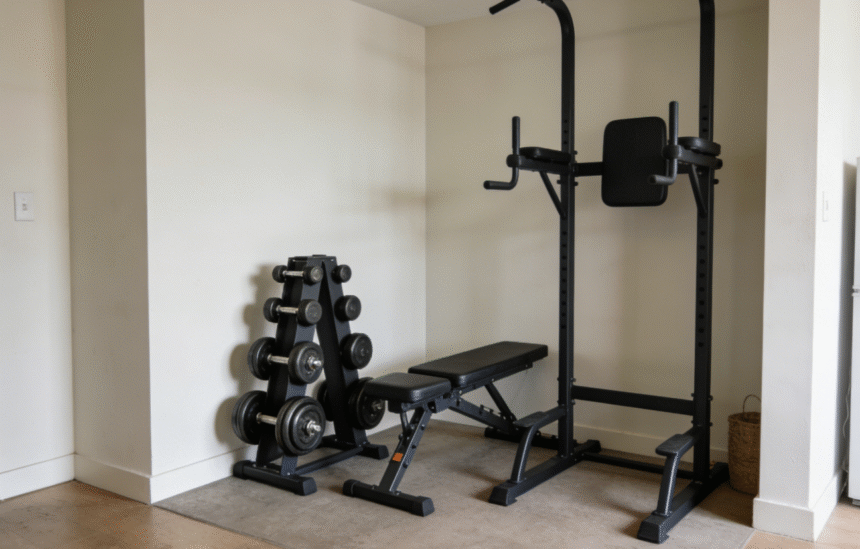
Once the resistance tools are in place, the next phase is to introduce structural support that expands the range of possible movements. A versatile weight bench or a compact power tower for home provides the necessary geometry for advanced training. The goal here is to find equipment that offers “structural versatility”—items that are light enough to move but stable enough to support significant loads.
A foldable weight bench, for example, transforms a pair of dumbbells into a full-body laboratory, allowing for incline presses, seated rows, and step-ups. Similarly, a well-designed structural station allows for bodyweight movements like pull-ups and dips, which are essential for functional upper-body strength. By focusing on these “anchor pieces,” you create a training environment that rivals any commercial gym in utility, while maintaining the flexibility to reclaim your floor space in seconds.
Ergonomic Precision and Industrial Design
Sustainability in a home gym context also refers to how equipment integrates with the human body and the modern living aesthetic. High-quality gear should prioritize ergonomic handle geometry and weight distribution balance, ensuring that every lift feels natural and secure. This precision in industrial design is what differentiates professional-grade tools from cheap alternatives.
Brands focusing on functional minimalism emphasize streamlined engineering and mechanical integrity. Instead of relying on decorative plastic or unnecessary bulk, the hardware is engineered for direct force transmission and a secure grip. This focus on the mechanical integrity of the equipment—such as the fast-locking mechanisms on adjustable sets—means fewer moving parts that could break over time. By choosing compact, modular systems, you are investing in an architectural solution for your health, where the equipment’s compact profile and high-load capacity work in harmony with a refined home interior.
Phase-Based Construction: From Basics to Advanced
Building a gym shouldn’t happen overnight. A sustainable model involves “Phase-Based Construction.” Start with a core set of dumbbells to establish a movement habit. Once the routine is stable, add a bench to unlock horizontal and incline pressing. Finally, integrate a pull-up station or a compact elliptical for cardiovascular conditioning.
This incremental approach allows you to verify the utility of each piece before committing more space or budget. It ensures that your Home Gym grows alongside your fitness level, preventing the common problem of “equipment graveyard” in the spare room. By maintaining a 0.2-square-meter footprint for each station, even a small studio apartment can become a high-performance training ground.
Conclusion: Sustainability Through Focused Choice
True sustainability in fitness is achieved when the environment supports, rather than hinders, the action. The best home gym is not the most expensive one, but the one that is most frequently used. By selecting tools that prioritize multi-functionality, industrial precision, and spatial economy, you remove the friction between your intention and your training.
When you invest in modular systems like those from FED Fitness, you are securing a professional-grade physical infrastructure that fits into your life. The power of a focused choice is that it grants you the freedom to train at your peak, anytime, without ever needing to leave your front door.